AI writing apps, design assistants, video generators, editing tools, automation platforms, and publishing dashboards are now easier to access than ever. For many businesses, this feels like progress. A social caption can be drafted quickly. A design variation can be produced in minutes. A rough video concept can be tested before a full production starts.
The problem is not that teams are using too many tools. The real problem is AI content tool sprawl: adding more AI media tools before deciding who owns the content, who reviews it, where it gets stored, when it gets published, and how it gets reused.
When that structure is missing, faster tools do not create a faster media operation. They create more files, more versions, more opinions, and more unfinished content.
Why AI content tool sprawl is becoming a bigger issue
Recent AI adoption trends show a clear pattern. Businesses are testing AI across editing, content planning, automation, software work, customer processes, and media production. Some teams are seeing individual tasks move much faster, but the wider business results are often less clear. That gap matters for content teams because publishing is not one task. It is a chain of decisions.
A caption draft is not a campaign. A generated image is not a brand asset. An edited clip is not a complete publishing plan. A faster app only helps when the output moves through a defined digital media workflow.
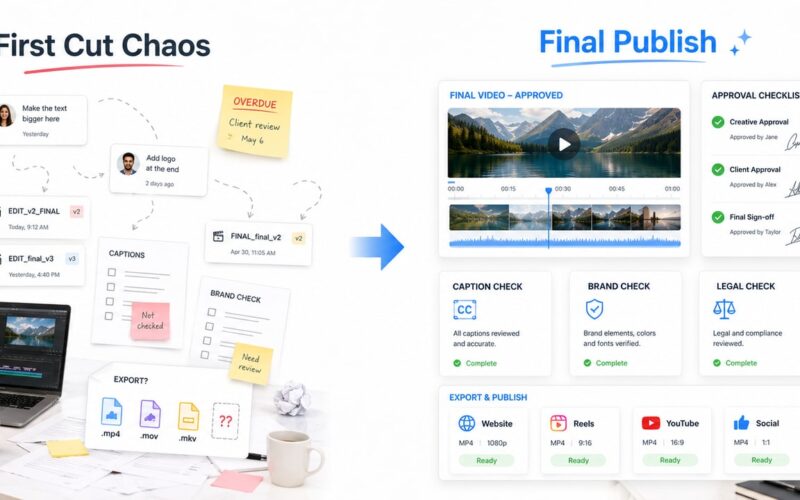
Without that workflow, teams often experience the same problems in different forms: duplicated designs, unclear approvals, inconsistent messaging, forgotten drafts, weak file naming, untracked edits, and content that never gets repurposed after publication.
The common mistake: treating AI output as the finish line
Many small teams make the mistake of using AI media tools as if they replace the publishing system. They generate ideas, captions, images, scripts, reels, newsletters, or website
, then assume the work is almost done.
But content still needs context. A team still needs to know which audience the piece is for, which platform it belongs on, what claim needs checking, what brand rule applies, who approves the final version, and how the asset connects to the wider business goal.
This is where the content publishing flow becomes more important than the tool itself. The flow turns scattered creative output into usable business communication.
A practical publishing flow for AI-assisted content
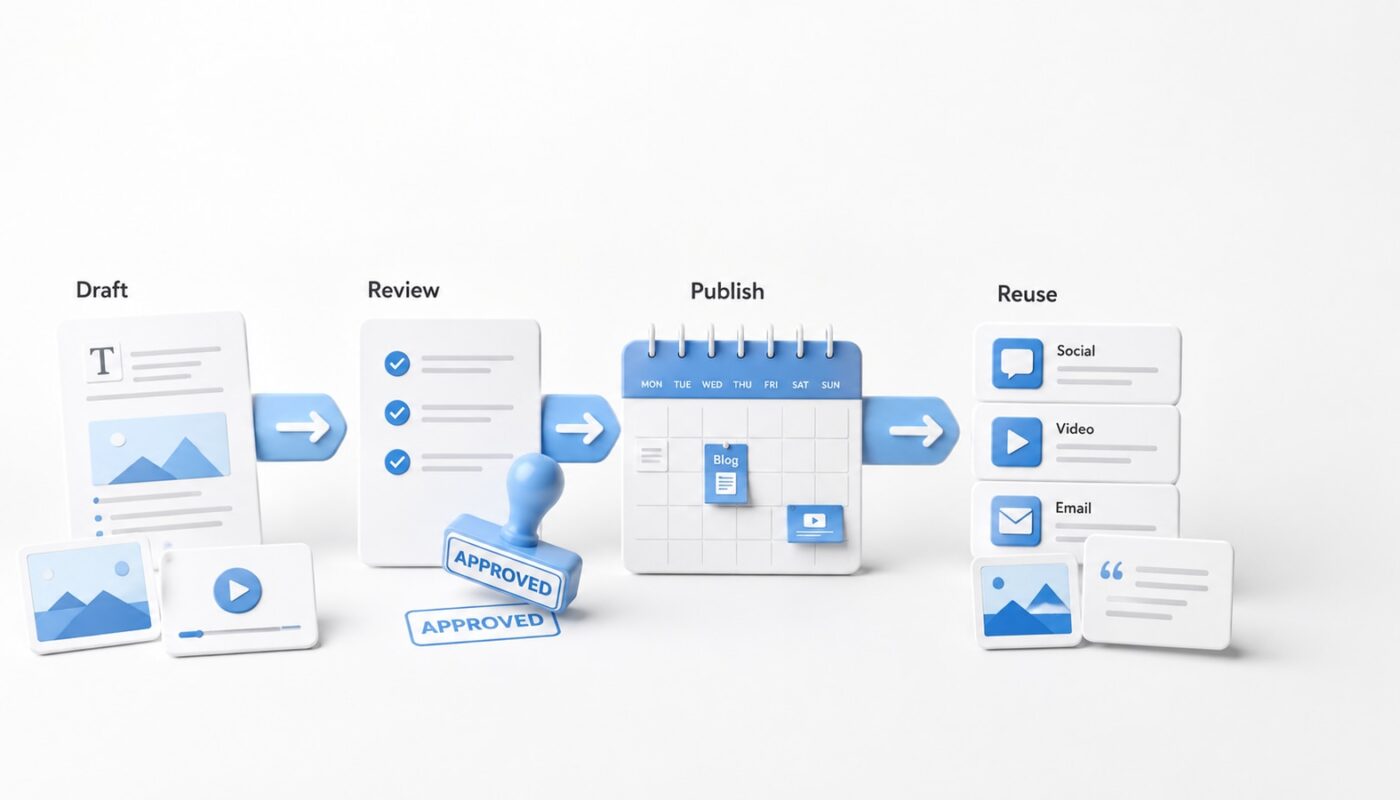
A strong AI-assisted content process does not need to be complicated. It needs to be visible, repeatable, and owned. A useful structure can follow five stages.
- Plan: Define the topic, audience, platform, message, format, and goal before opening the AI tool.
- Create: Use AI media tools to draft, edit, explore variations, summarise material, or speed up production tasks.
- Review: Check accuracy, tone, brand fit, visual quality, legal sensitivity, and whether the message is appropriate for the audience.
- Publish: Schedule or upload the approved version with the correct caption, image, tags, links, and platform formatting.
- Reuse: Convert the asset into smaller posts, email content, website sections, proposal proof, sales material, or internal documentation.
This simple sequence prevents AI work from becoming a pile of disconnected drafts. It also makes it easier for designers, writers, managers, and business owners to understand where each piece of content currently sits.
Define ownership before adding another app
Before buying or testing another AI content tool, ask a basic workflow question: who owns each stage?
- Who approves the content idea before production starts?
- Who checks AI-generated text for accuracy and brand tone?
- Who decides which visual direction is correct?
- Who has final approval before publishing?
- Who stores the final assets and updates the content calendar?
- Who decides how the content can be reused later?
These questions are not admin for the sake of admin. They protect the team from confusion. A clear content approval process helps AI speed support the business instead of creating extra review pressure.
Build one source of truth for content assets
AI content tool sprawl becomes worse when every tool stores outputs in a different place. One draft is in a chat. Another is in a design app. A video script is in a document. The final caption is in a WhatsApp message. The approved image is on someone’s desktop.
A better approach is to create one source of truth. This can be a shared drive, project management board, content calendar, digital asset library, website backend, or a custom system platform. The exact tool matters less than the rule: approved content should be easy to find, understand, and reuse.
For each content item, store the final version, source files, platform notes, approval status, publish date, related campaign, and reuse ideas. This turns daily media work into a growing business asset instead of a temporary production task.
Use AI where it fits the workflow
AI is useful when it supports a specific step. It can help generate first drafts, organise interview notes, suggest social variations, create content outlines, resize ideas for different channels, identify repeated themes, or speed up basic editing tasks. It is less useful when it is asked to make strategic decisions without context.
For a small team, the goal should not be to use AI everywhere. The goal should be to use AI at the points where it reduces friction while keeping human judgement in the places that affect trust, brand meaning, accuracy, and client relationships.
A quick checklist before adopting more AI media tools
- Do we know what problem this tool solves in our current workflow?
- Do we have a clear review and approval process?
- Will this tool connect to our content calendar or asset storage?
- Can we measure whether it saves time beyond the first draft?
- Will the output match our brand standards after review?
- Can the final content be reused across platforms?
If the answer is unclear, the team may not need another tool yet. It may need a better digital strategy for teams: one that connects content planning, AI assistance, design, publishing, automation, and reporting into a working system.
The takeaway
AI can make media production faster, but speed only becomes valuable when the team has a publishing flow. Without ownership, review, storage, publishing, and reuse, AI content tool sprawl creates more movement without enough progress.
Digivolve Media helps businesses turn disconnected digital tools into clearer media systems, from content workflows and websites to automation, digital platforms, brand communication, and publishing processes. The right strategy is not just about choosing better apps. It is about building a flow that helps the team create, approve, publish, and reuse content with confidence.