Many growing businesses know they need better brand consistency, but they often start with the wrong tool. One team asks for brand guidelines when the real problem is slow social media production. Another builds design templates before the logo, colours, typography, and image style are clear. A third keeps redesigning website sections because there is no shared component structure.
This visual identity tool comparison helps you decide what to build first: a brand kit, a content template system, or a component library. Each one supports brand consistency, but each solves a different operational problem.
The Simple Difference Between the Three Tools
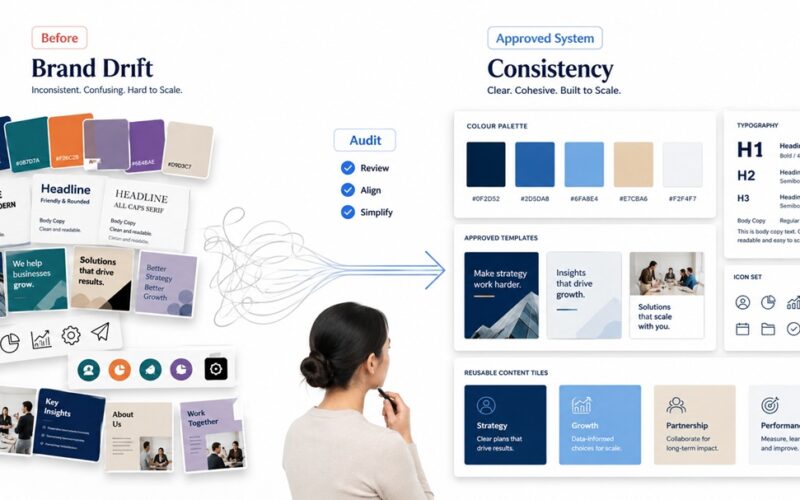
A brand kit is the foundation. It usually includes your logo files, colour palette, typography, icon style, image direction, basic usage rules, and essential brand assets. It helps people understand how the brand should look before they create anything.
A content template system turns that identity into repeatable layouts for social posts, ads, email graphics, presentations, proposals, thumbnails, campaign posts, and other recurring content. It helps teams create faster without making every design from scratch.
A component library is a structured set of reusable interface parts for websites, landing pages, portals, apps, and digital platforms. It may include buttons, cards, forms, navigation sections, banners, pricing blocks, testimonial sections, and dashboard elements.
The common mistake is treating these as interchangeable. A brand kit defines the visual language. A template system applies it to content production. A component library applies it to digital product and website interfaces.
Start With the Problem, Not the Tool
Before choosing what to build first, look at where your team is losing time or consistency. The right online brand toolkit depends on your daily workflow.
- Choose a brand kit first if different people are using different colours, fonts, logos, image styles, or document layouts.
- Choose a content template system first if your team already has a clear identity but spends too much time designing recurring posts, campaigns, and sales materials.
- Choose a component library first if your website, app, portal, or platform keeps growing and every new page is being designed differently.
This is why the brand kit vs design system discussion can be confusing. A full design system may include brand rules, content patterns, interface components, code references, and governance. Most small and medium businesses do not need to start there. They need the smallest useful tool that fixes the current bottleneck.
When to Build a Brand Kit First
Build a brand kit first when the business has not yet agreed on its visual basics. This is common in companies that started quickly, outsourced work to different suppliers, or created content across many platforms without a central source of truth.
A practical brand kit should include approved logo versions, colour values, typography choices, basic spacing guidance, image treatment, icon direction, sample layouts, and a short list of do and do not rules. It should be easy enough for a designer, marketer, developer, or manager to use without reading a long brand document.
The goal is not to create a beautiful PDF that no one opens. The goal is to stop visual guesswork. Once the foundation is clear, every other brand tool becomes easier to build.
When to Build a Content Template System First
Build a content template system when your team creates the same types of content every week. This could include announcement posts, product highlights, service explainers, staff introductions, event graphics, blog feature images, quote cards, WhatsApp updates, LinkedIn carousels, or campaign layouts.
A good content template system includes editable layouts, rules for replacing images and text, format variations for different platforms, and clear examples of finished content. It should make production faster while still leaving room for creative judgement.
The most useful templates are based on real content needs, not imagined scenarios. Start with the five to ten formats your team uses most often. Then add more only when there is a repeated need.
When to Build a Component Library First
Build a component library when the brand appears across websites, portals, dashboards, landing pages, or digital systems. This is especially useful when designers, developers, and content teams all touch the same digital platform.
A component library gives your team reusable building blocks. Instead of redesigning a call-to-action block, contact form, service card, or pricing section every time, the team selects from approved components and adapts the content. This improves consistency and reduces unnecessary design and development repetition.
For most businesses, the first version does not need to be complex. Start with the components that appear on high-value pages: hero sections, buttons, form fields, cards, navigation, content blocks, testimonials, and enquiry sections.
A Practical Build Order for Most Teams
If your team is unsure, use this order as a safe starting point:
- Define the brand kit. Confirm the visual basics so everyone is working from the same foundation.
- Create the content template system. Turn the identity into repeatable layouts for your most common marketing and communication needs.
- Build the component library. Structure the reusable interface elements for your website, landing pages, systems, and digital platforms.
- Document the workflow. Explain who can edit, approve, publish, and update each tool.
This order works because it moves from identity to production to platform structure. It also prevents teams from overbuilding a system before they know what their real content and website needs are.
Implementation Checklist
Before starting, gather your current logo files, social posts, website pages, presentations, proposal documents, campaign graphics, and sales materials. Review them as a set. Look for inconsistency, repetition, slow production points, and places where teams are rebuilding the same thing.
- List the content formats created most often.
- Identify which brand decisions are unclear.
- Find repeated website or platform sections.
- Decide who owns updates and approvals.
- Choose where the toolkit will live so the team can actually access it.
The best visual identity implementation is not the biggest system. It is the one your team can use consistently. A small, clear toolkit is more valuable than a complex library that no one maintains.
Final Thought
For businesses improving their online presence, brand tools should support real work: publishing faster, keeping content consistent, improving websites, and helping teams collaborate. Digivolve Media approaches branding and visual identity as part of a wider digital workflow, connecting design, websites, systems, automation, and content production into practical tools that teams can use every day.