Humanitarian operations, organised.
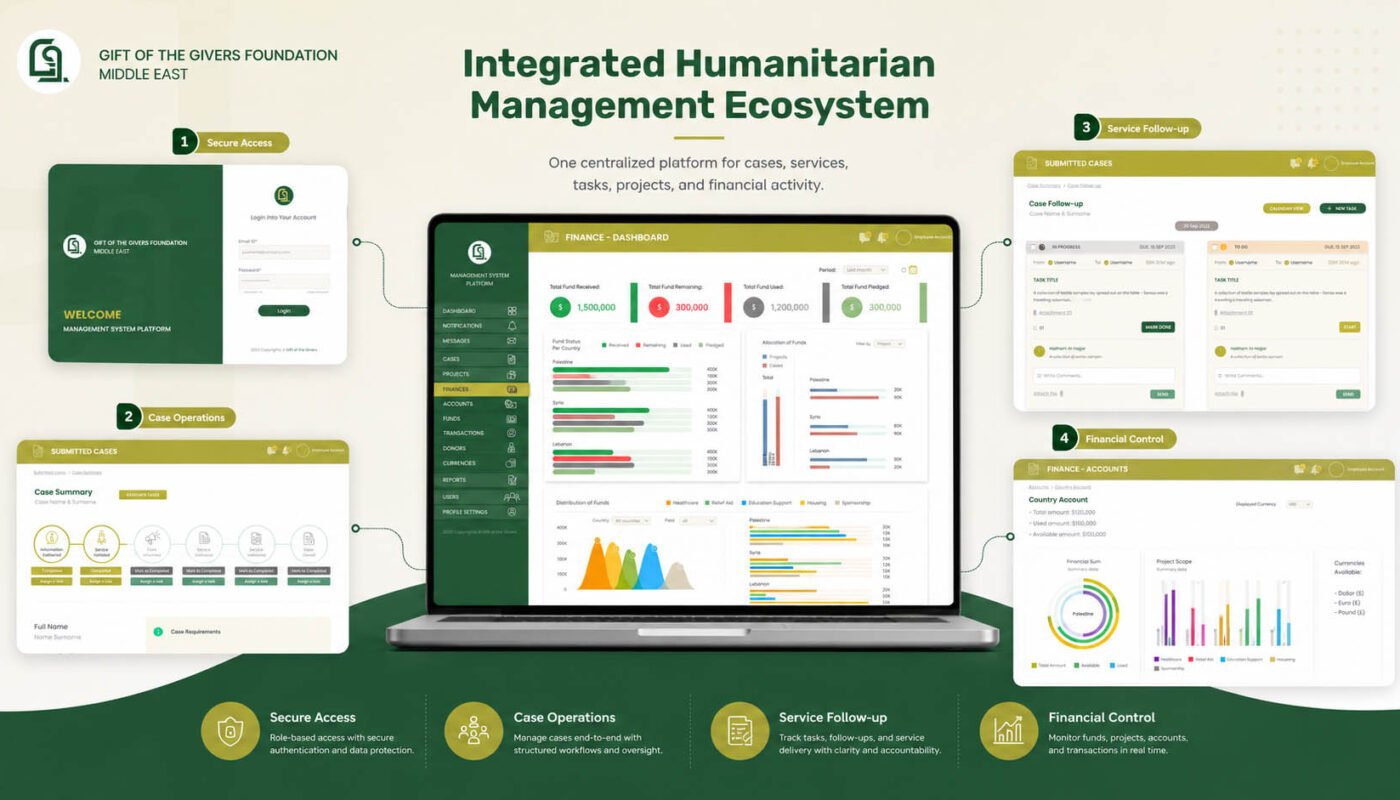
We built the Gift of the Givers Middle East Management System as a centralised platform for humanitarian operations — designed so that staff in the field, the office, and the finance team work from the same source of truth on every beneficiary case, every service delivered, and every dollar moved.
The mission
Humanitarian operations look simple from the outside and are anything but. A single beneficiary case might start with a phone call, pass through a needs assessment, get matched to a service, escalate through approvals, draw down on a project’s funds, and end with a field visit weeks later. Multiply that by hundreds of active cases across multiple countries, in multiple currencies, with multiple donors expecting reports — and the operational complexity becomes the work itself.
Gift of the Givers Middle East needed a system that could carry that complexity without becoming bureaucracy — one that supported the staff doing the work rather than the work itself becoming the system.
Beneficiary cases as the core unit
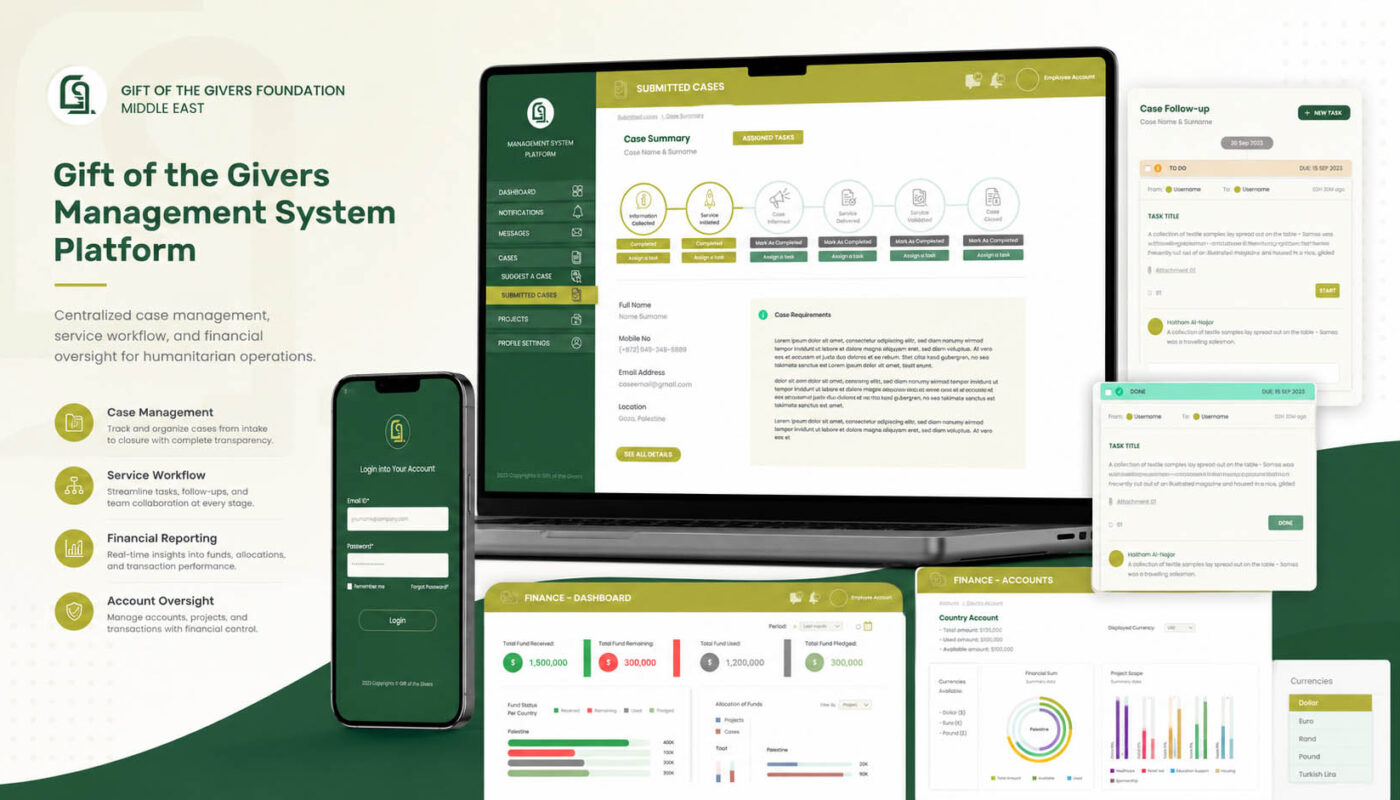
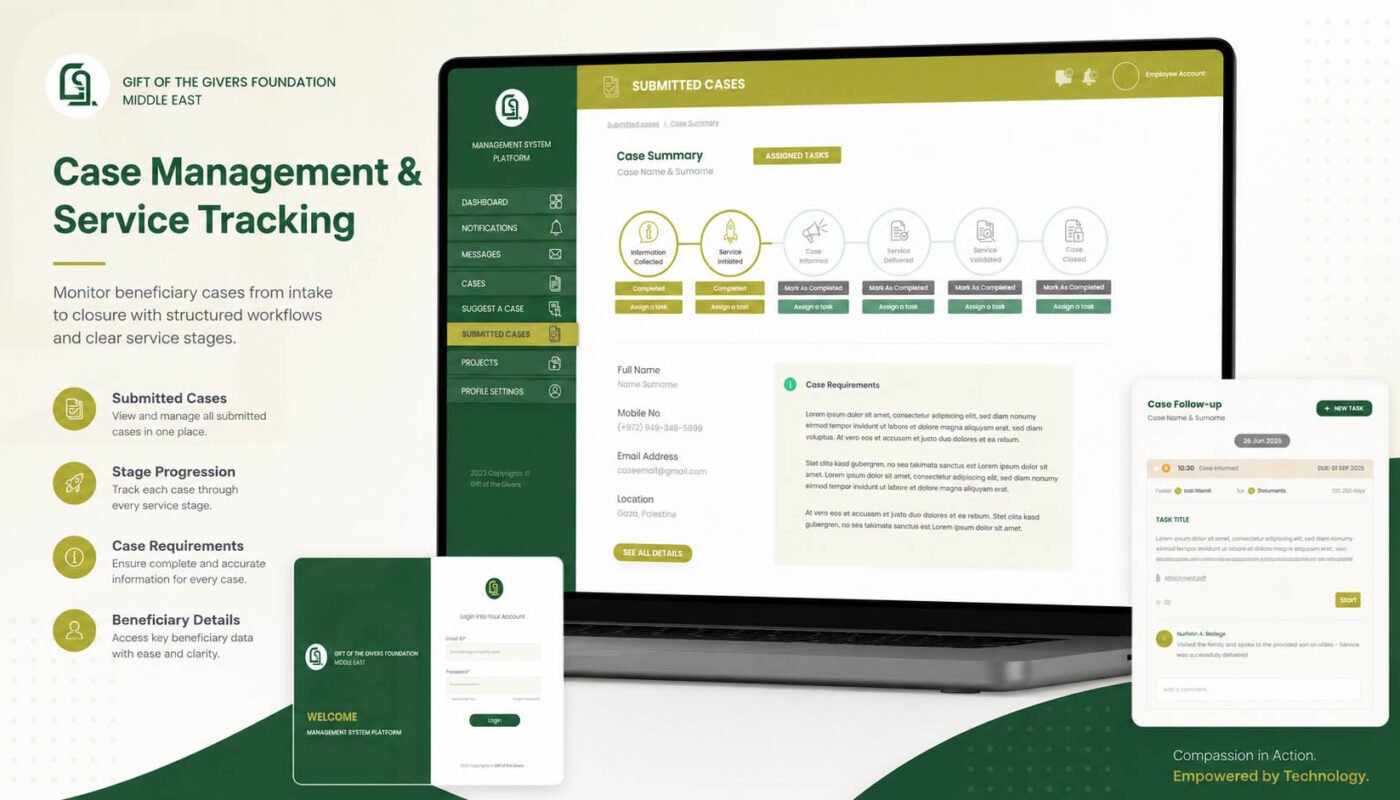
Every workflow in the platform begins with a case. A staff member registers a beneficiary — full name, location, contact details, situation — and the case enters the system at the Information Collected stage. From there it moves through a structured lifecycle: Service Initiated, Case Informed, Service Delivered, Service Validated, Case Closed. Each stage has its own requirements, its own approvals, and its own audit trail.
This isn’t a technical exercise. The stages mirror how Gift of the Givers actually works in the field — identifying need, mobilising response, delivering aid, confirming impact, closing the loop. Building the software around the existing workflow (rather than the other way around) means staff don’t have to translate their work into the system’s language. The system speaks theirs.
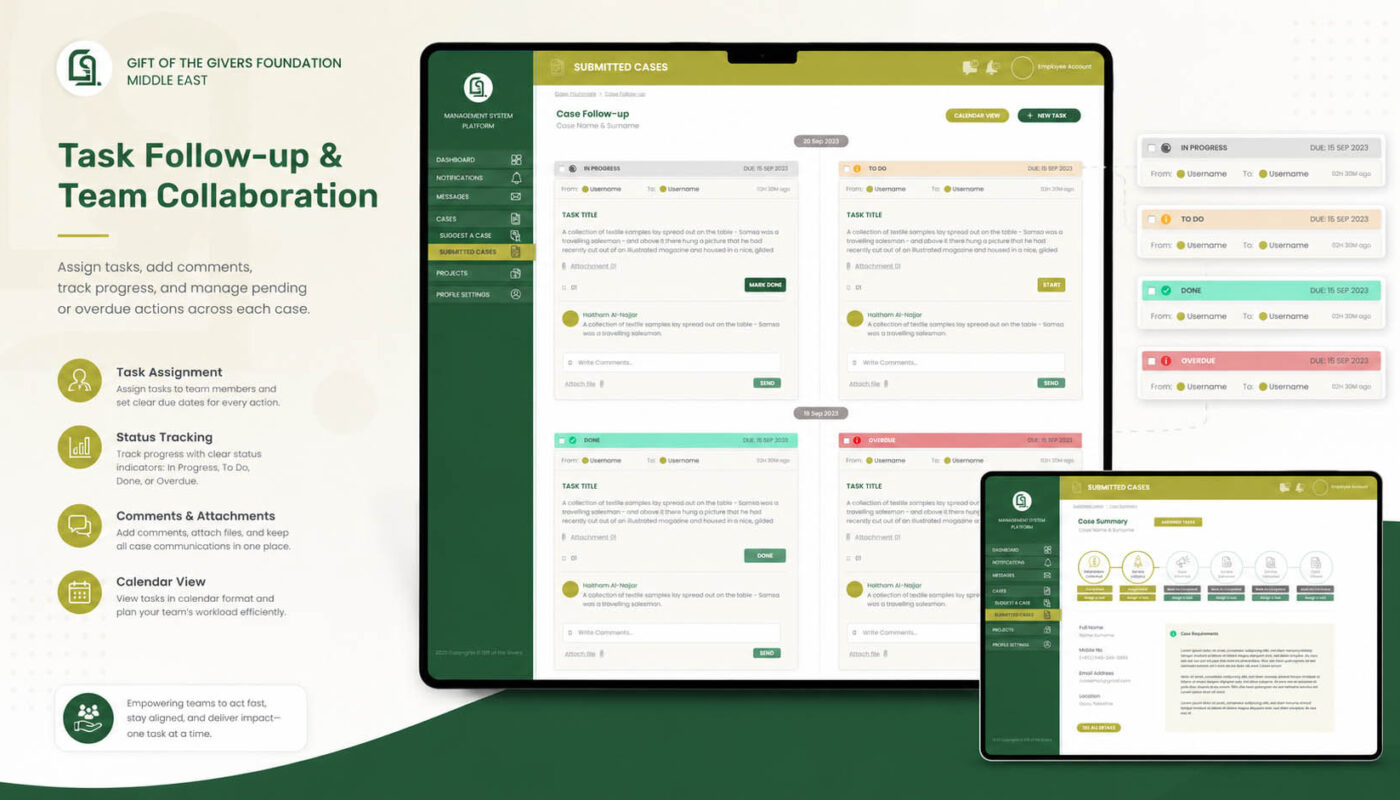
Task follow-up & team coordination
Inside each case sits the day-to-day reality: tasks assigned to specific team members, with due dates, status indicators, comments, and file attachments. A status like To Do, In Progress, Done, or Overdue tells the team at a glance what’s moving and what’s stuck. A calendar view shows the week ahead so workload can be planned, not just reacted to.
Comments and attachments live inside the case rather than in scattered emails. When a field worker visits a family, takes photos, has a conversation, and confirms a service was delivered, that record goes directly into the case — not into a separate report that needs to be reconciled later. Six months on, a manager looking at any closed case sees the actual story of what happened, in the words of the people who were there.
Funds tracked with the rigour donors expect
Donor confidence is built on accountability. The finance module shows total funds received, used, remaining, and pledged — at the platform level, at the country level, and at the individual project level. Charts visualise fund status by country and the allocation of funds across humanitarian sectors: healthcare, relief aid, education support, housing, sponsorship.
Multi-currency support is built in from the foundation — Dollar, Euro, Rand, Pound, Turkish Lira — because humanitarian operations don’t respect single-currency assumptions. Each country account shows total received, used, and available amounts in its operating currency, with conversion to a reporting currency for consolidated dashboards.
Transaction history & audit trail
Every movement of money — revenue received, transfers between accounts, donations recorded, payments made — gets logged with sender, recipient, amount, status, and approval state. The transaction history isn’t a separate audit feature bolted on at the end; it’s the natural by-product of doing the work inside the system. When auditors arrive, when a donor asks for a report, when a board member wants to understand a country’s financial position, the data is already there.
This matters in humanitarian work in a way it doesn’t in commercial software. The trust between an organisation and its donors is what funds the next project. The platform is designed to make that trust visible.
Built around the people doing the work
Role-based access keeps the platform usable. A field worker sees their cases and tasks. A country coordinator sees their region’s projects and funds. The finance team sees the financial whole. Leadership sees everything. The same data, presented with different scope for different responsibilities — so nobody is drowning in screens that don’t apply to them.
Notifications, messages, and a dedicated suggestion feature (“Suggest a case”) give staff lightweight ways to surface issues, share updates, and propose new work — the small interactions that keep a distributed team aligned without forcing everything through formal channels.
Compassion in action. Empowered by technology.
The platform doesn’t deliver aid. The people of Gift of the Givers do that, often in difficult places, under difficult conditions. What the system can do is reduce the friction between intention and impact — so that more energy goes into the work and less into the administration around it. Faster intake, clearer coordination, tighter financial control, better reporting.
Thirty-two weeks from kickoff to a production-ready platform: 250 pages designed and built, 120 features across case management, task coordination, finance, and reporting, six service stages tracked through every case lifecycle, and a foundation designed to grow alongside the work for years to come.