A research archive, made navigable.
We built the new AMEC platform around what the institute actually publishes — a deep archive of independent analysis on the Middle East and its relationship with Africa, designed so researchers, journalists, and policymakers can find the right piece quickly and read it without distraction.
The brief
The Afro-Middle East Centre has spent years building one of the few independent research bodies focused specifically on the relationship between Africa and the Middle East. The work shows: substantive analyses on Yemen, Sudan, Palestine, Saudi-Israeli dynamics, maritime security in West Africa, Algerian-Moroccan relations. Their existing website wasn’t doing the archive justice — content was hard to find, the publishing workflow was friction, and the donation system needed to be visible without becoming pushy.
The new platform had to do three things well: surface the right content to the right reader, give the team a publishing workflow that doesn’t get in the way, and support fundraising with dignity rather than urgency.
Built around the archive
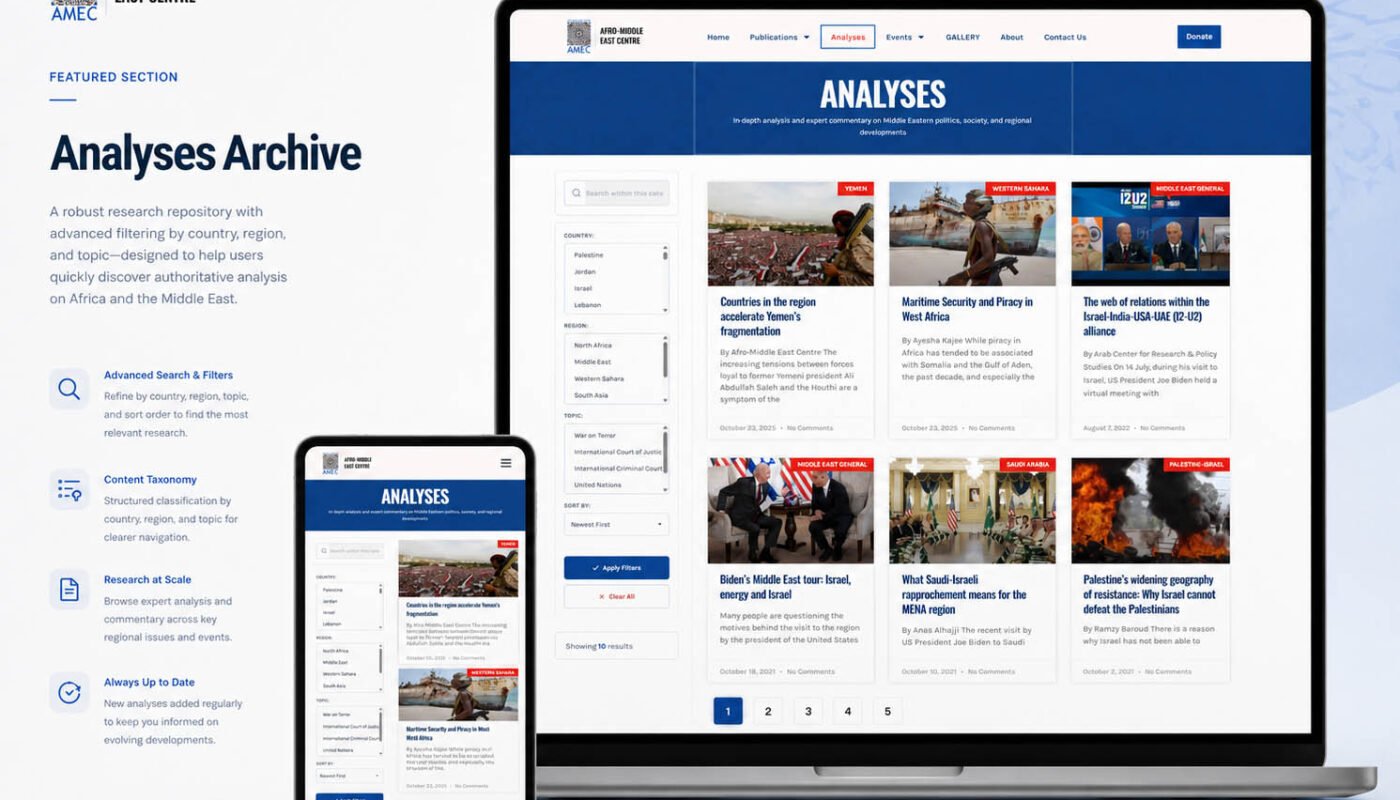
AMEC publishes across content types — articles, analyses, reports, events, video commentary — and across geographies and topics that overlap heavily. A piece on Israel’s relations with India and the UAE belongs simultaneously under Middle East General, under specific countries, and under topics like “international court of justice” or “war on terror.” A traditional category tree would have collapsed under that complexity.
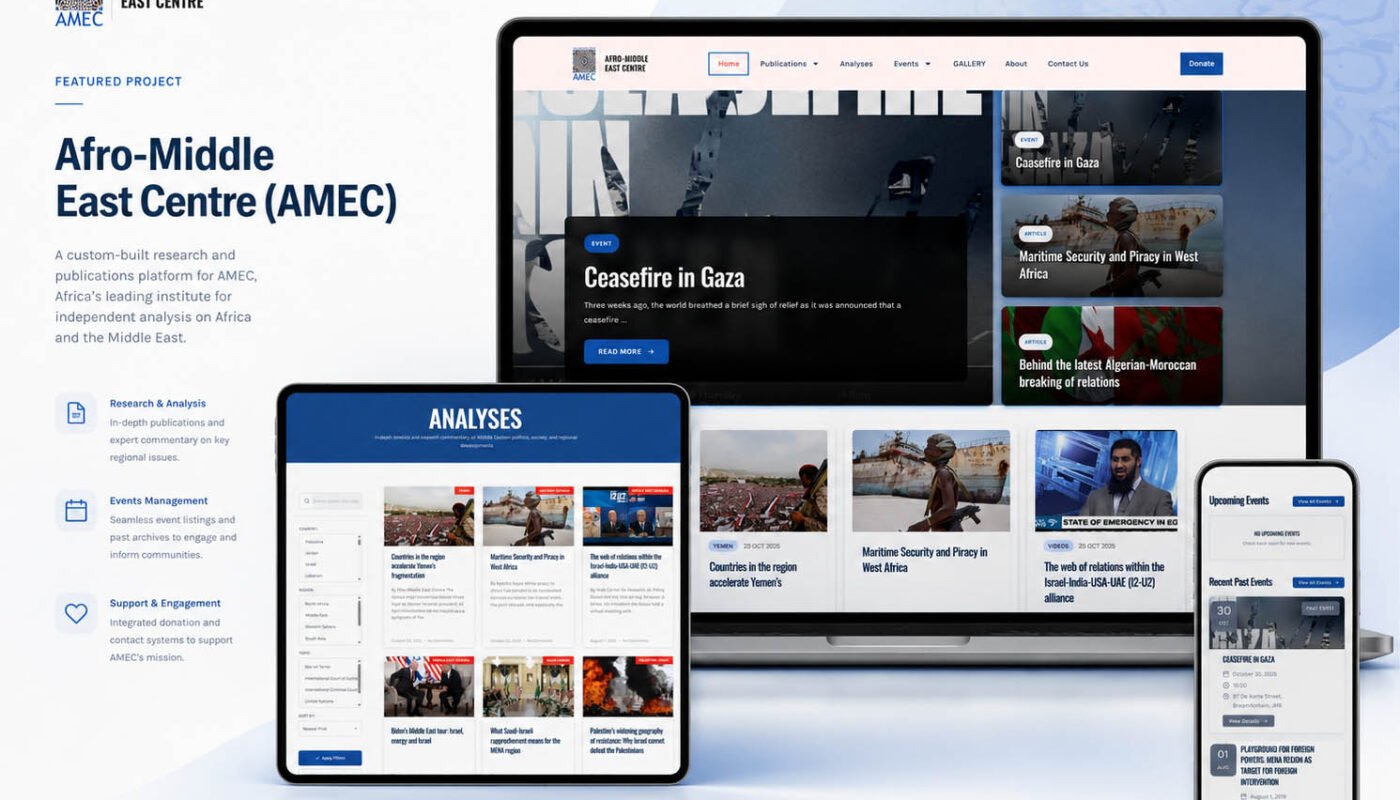
We built a faceted taxonomy: country, region, topic, content type. Every piece can be tagged on all four axes simultaneously. The analyses archive surfaces this directly — a sidebar of filters (Palestine, Jordan, Israel, Lebanon; North Africa, Middle East, Western Sahara, South Asia; War on Terror, ICC, UN; Articles, Analyses, Reports, Events) lets a reader narrow from “everything AMEC has published” down to “Yemen analyses from the last six months” in two clicks. The 86 articles in the archive at launch became searchable as a real research repository, not a flat reverse-chronological feed.
A homepage that respects the work
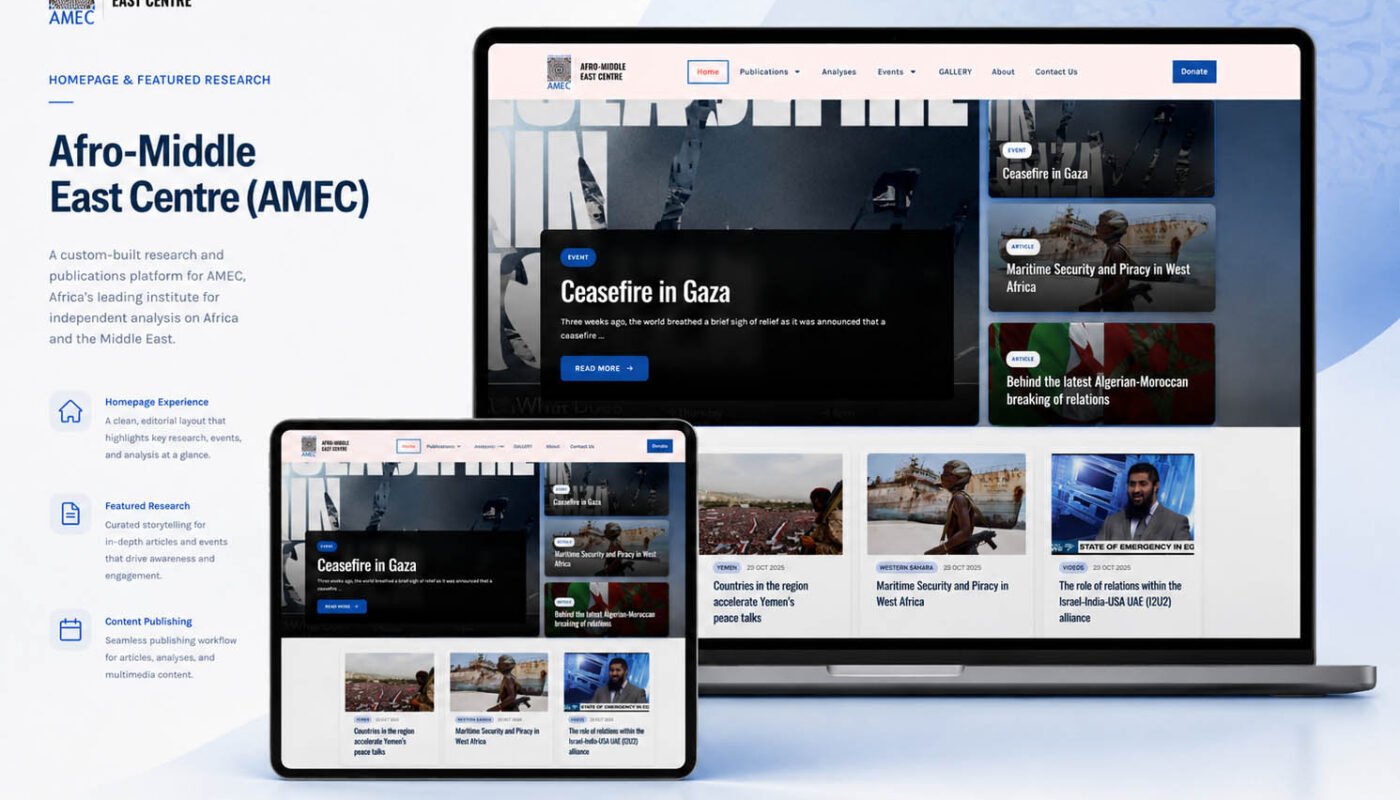
The homepage leads with a featured-content hero — a single piece given full visual weight, usually a recent flagship analysis or a major event. Ceasefire in Gaza, for example, set against a documentary image of the words “Ceasefire In” partially visible in graffiti. Below it, a structured rail of recent articles and events. Then a grid of recent country-tagged pieces with cover images, regional badges, and dated bylines.
The visual restraint is deliberate. AMEC’s content speaks for itself; the platform’s job is to step back. Strong typography, clear hierarchy, generous space — the kind of layout that signals “serious publication” without resorting to pretentious flourishes.
An events system that works for actual events
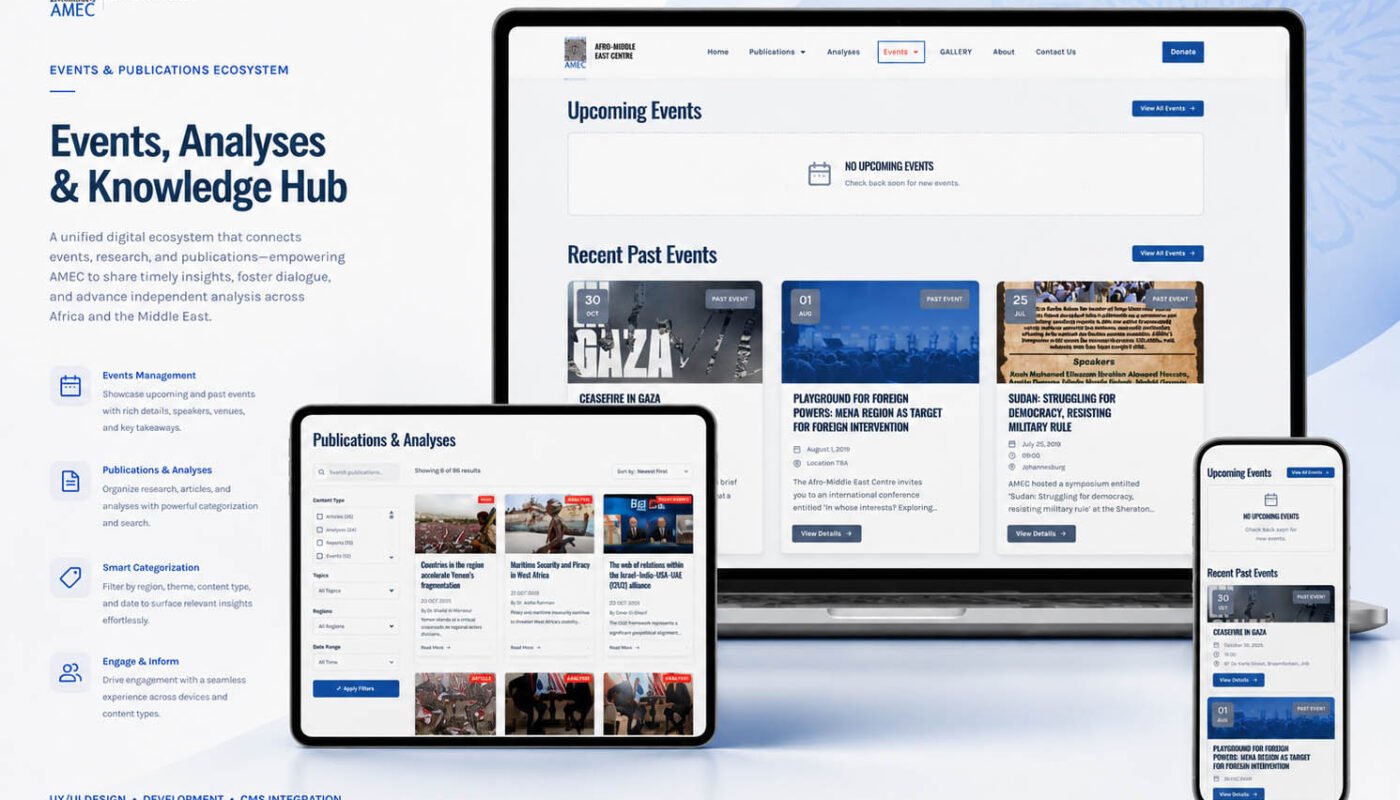
AMEC runs conferences, seminars, public discussions, and policy roundtables — events that need proper logistics, speaker lineups, and post-event archives. We built a dedicated events module with upcoming and past listings, detail pages that include date, time, location, speaker information, and supporting media. Past events stay visible permanently, becoming part of the institutional record (the Sudan: Struggling for Democracy symposium from July 2019 is still discoverable today).
The same admin interface that publishes articles publishes events — no separate plugin, no separate workflow. The team writes, attaches images, sets metadata, and publishes through one consistent UI.
A donation system built on WooCommerce
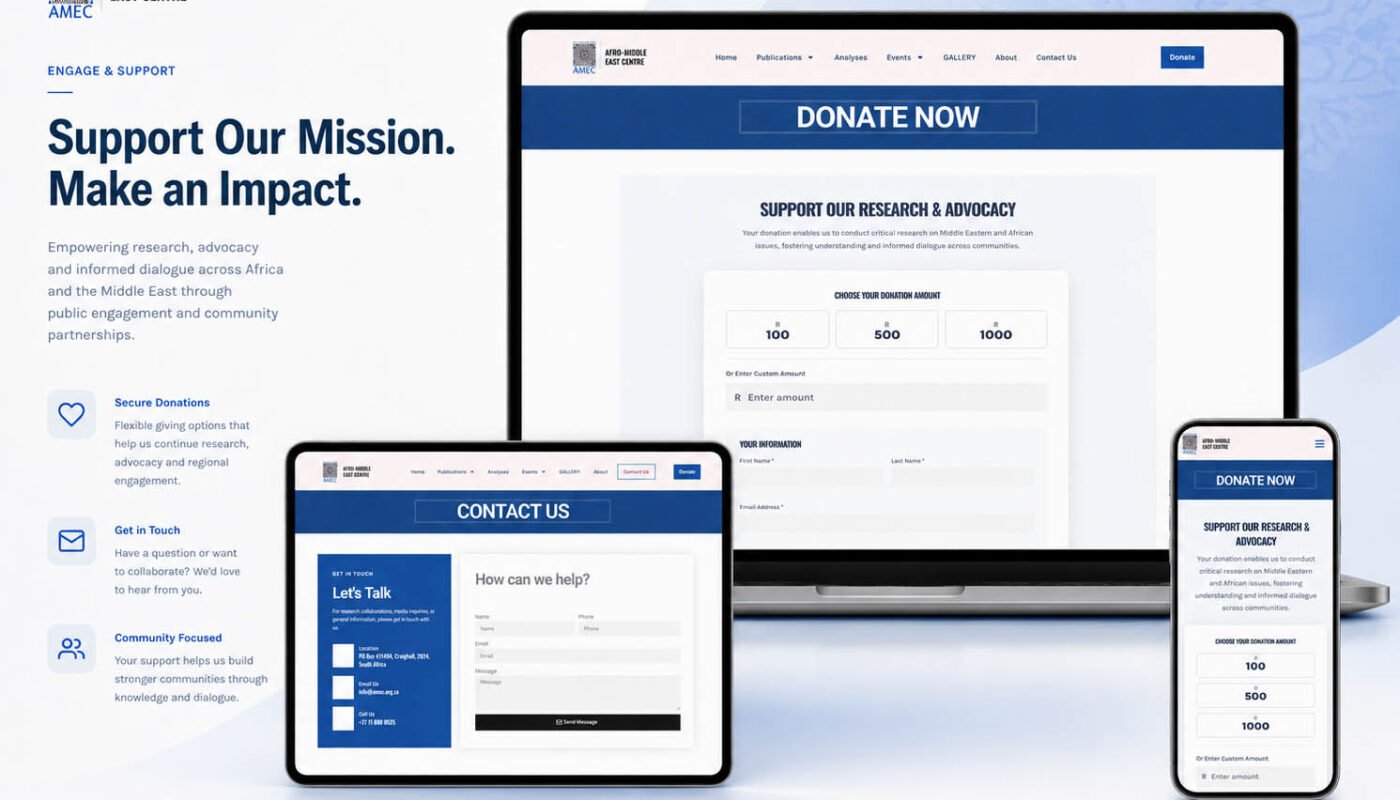
Donations were the trickiest piece. AMEC wanted secure card processing, multiple preset amounts, custom amount entry, and full donor information capture — but the donor flow had to feel like a contribution, not a checkout. We built the system on WooCommerce (proven, audited, secure), then transformed the language across every touchpoint: “Add to cart” became “Donate”; “Order” became “Contribution”; “Customer” became “Donor”. The technical foundation stayed best-in-class; the experience felt purpose-built.
The donation page leads with a clear statement of purpose — Your donation enables us to conduct critical research on Middle Eastern and African issues — then offers R100, R500, R1000 preset amounts plus a custom field, followed by donor information. No upsells, no urgency timers, no guilt. The conversion rate isn’t measured by friction reduction; it’s measured by whether donors feel respected.
A CMS the editorial team actually uses
Research institutes don’t have dedicated web teams. The same person writing an analysis often publishes it. We built the CMS for that reality — a clean admin interface where authors can write articles, attach images, set country/region/topic tags, and publish without needing to think about HTML, image optimisation, or category taxonomies. Drafts auto-save. Edits propagate live. Categorisation surfaces in plain language (“Tag this analysis with the relevant countries and topics”) rather than in WordPress jargon.
The result: faster publishing, fewer mistakes, and an editorial workflow that scales as the archive grows.
Built for the long term
Research platforms live for decades, not seasons. Every decision — the taxonomy structure, the URL patterns, the CMS architecture, the donation infrastructure — was made with that horizon in mind. AMEC’s new platform isn’t optimised for traffic spikes or viral moments; it’s optimised for being the place that researchers, journalists, and policymakers come back to, year after year, when they need authoritative analysis on Africa-Middle East affairs.
Four weeks from kickoff to launch: 10 core pages, 17 platform features across publishing, events, fundraising, and engagement, 86 articles indexed in the new archive structure, and an editorial foundation built to support the next decade of AMEC’s work.